
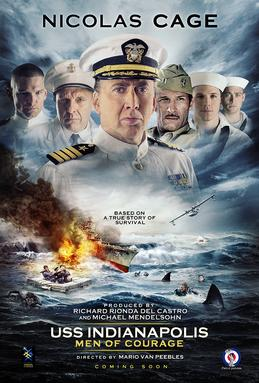
USS Indianapolis: Men of Courage (also known as USS Indianapolis: Disaster in the Philippine Sea) is a 2016 American war drama directed by Mario Van Peebles. Written by Cam Cannon and Richard Rionda Del Castro, the film is inspired by the real-life sinking of the USS Indianapolis during the final days of World War II. The cast includes Nicolas Cage, Tom Sizemore, Thomas Jane, Matt Lanter, Brian Presley, and Cody Walker.
Filming began on June 19, 2015, in Mobile, Alabama. The movie had its premiere in the Philippines on August 24, 2016, and was later released in the U.S. on October 14, 2016, through digital platforms like iTunes and Amazon, followed by a limited theatrical release around Veterans Day. Despite its historical subject matter and notable cast, the film struggled commercially and was met with largely negative reviews from critics.
In 1945, during the final days of World War II, the USS Indianapolis, a Portland-class heavy cruiser under the command of Captain Charles McVay, completed a top-secret mission delivering components for the atomic bomb later dropped on Hiroshima. Shortly after completing its mission, on July 30, the ship was traveling alone through the Philippine Sea when it was struck by torpedoes fired by the Japanese submarine I-58. Around 300 crew members went down with the ship, while the remaining sailors were left adrift in the open ocean.
Over the course of five harrowing days, the stranded sailors endured extreme conditions without food or fresh water. Many succumbed to dehydration, saltwater poisoning, and injuries, while others were attacked by sharks. Some men, driven to hallucinations by thirst and exhaustion, swam off in search of imaginary islands and were never seen again. On the fifth day, a Navy PBY Catalina patrol aircraft spotted the survivors, prompting a rescue operation. Out of approximately 1,200 crew members, only 316 were rescued alive.
Following the tragedy, the U.S. Navy sought to assign blame and brought Captain McVay to trial, accusing him of endangering his ship by not zigzagging, a standard evasive maneuver. Despite testimony in his favor—including from the commander of the Japanese submarine—and significant evidence clearing him of wrongdoing, McVay was convicted. Years later, weighed down by grief, public scrutiny, and ongoing harassment from families of lost sailors, McVay died by suicide in 1968.
The film concludes with a postscript explaining that in 2000, President Bill Clinton officially exonerated Captain McVay. As the credits roll, two Navy veterans discuss the shark attacks, while actual footage of the rescue and photographs of the fallen crew are shown, honoring those who were lost.


Leave A Comment